

-
Forces of Nature with Brian Cox
-
BBC
Professor Brian Cox combines some of the most spectacular sights on Earth with our deepest understanding of the universe to reveal how the planet's beauty is created by just a handful of forces.
- TV-Recordings
- English subtitles
- 240
Professor Brian Cox combines some of the most spectacular sights on Earth with our deepest understanding of the universe to reveal how the planet's beauty is created by just a handful of forces.
-
Hidden Kingdoms
-
BBC
Immerse yourself in the lives of extraordinary characters that stand a few inches tall. From chipmunks to mice, be entertained and spellbound by the creatures that call the Hidden Kingdoms home.
- TV-Recordings
- English subtitles
- 180
Immerse yourself in the lives of extraordinary characters that stand a few inches tall. From chipmunks to mice, be entertained and spellbound by the creatures that call the Hidden Kingdoms home.

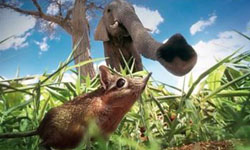
This is the story of two young animals forced to grow up fast. In Africa's savannah, a baby elephant shrew learns how speed is the secret to survival amongst the largest animals on Earth; and in America, a young grasshopper mouse confronts the Wild West's deadliest creatures to stake a claim of his own.
- TV-Recordings
- Natural World
- English subtitles
- 60
This is the story of two young animals forced to grow up fast. In Africa's savannah, a baby elephant shrew learns how speed is the secret to survival amongst the largest animals on Earth; and in America, a young grasshopper mouse confronts the Wild West's deadliest creatures to stake a claim of his own.
This is the story of two tiny animals coming of age.
- TV-Recordings
- Natural World
- English subtitles
- 60
This is the story of two tiny animals coming of age.
This episode looks at the issues that will change the way we live our lives in the future. Rather than relying on the minds of science fiction writers, mathematician Hannah Fry delves into the data we have today to provide an evidence-based vision of tomorrow. With the help of the BBC's science experts - and a few surprise guests - Hannah investigates the questions the British public want answered about the future.
- TV-Recordings
- English subtitles
- 60
This episode looks at the issues that will change the way we live our lives in the future. Rather than relying on the minds of science fiction writers, mathematician Hannah Fry delves into the data we have today to provide an evidence-based vision of tomorrow. With the help of the BBC's science experts - and a few surprise guests - Hannah investigates the questions the British public want answered about the future.
Changes to the bacteria that live inside all of us are responsible for increasing the number of people with allergies, suggests new research.
- TV-Recordings
- Medical Sciences
- English subtitles
- 60
Changes to the bacteria that live inside all of us are responsible for increasing the number of people with allergies, suggests new research.
We are in the grip of an allergy epidemic. 50 years ago one in 30 were affected, but in Britain today it is closer to one in three. Why this should be is one of modern medicine's greatest puzzles.
- TV-Recordings
- Biology
- Medical Sciences
- TV-Recordings
- No subtitles
- 58
We are in the grip of an allergy epidemic. 50 years ago one in 30 were affected, but in Britain today it is closer to one in three. Why this should be is one of modern medicine's greatest puzzles.
It's the process that powers the Sun, and scientists know that if they could just make nuclear fusion happen here on Earth they could solve all the world's energy problems. Billions of dollars have been spent on trying to make it happen, but now an American scientist claims to have created nuclear fusion simply by bombarding a flask of liquid with sound waves. Many scientists refuse to believe his claims, so Horizon has assembled a team to replicate the experiment. This film reveals the team's findings
- TV-Recordings
- Physics
- TV-Recordings
- No subtitles
- 11
It's the process that powers the Sun, and scientists know that if they could just make nuclear fusion happen here on Earth they could solve all the world's energy problems. Billions of dollars have been spent on trying to make it happen, but now an American scientist claims to have created nuclear fusion simply by bombarding a flask of liquid with sound waves. Many scientists refuse to believe his claims, so Horizon has assembled a team to replicate the experiment. This film reveals the team's findings

Dr Alice Roberts asks one of the great questions about our species: are we still evolving? Alice follows a trail of clues from ancient human bones, to studies of remarkable people living in the most inhospitable parts of the planet, to the frontiers of genetic research to discover if we are still evolving - and where we might be heading.
- TV-Recordings
- Anthropology
- TV-Recordings
- English subtitles
- 60
Dr Alice Roberts asks one of the great questions about our species: are we still evolving? Alice follows a trail of clues from ancient human bones, to studies of remarkable people living in the most inhospitable parts of the planet, to the frontiers of genetic research to discover if we are still evolving - and where we might be heading.

Professor Brian Cox takes a global journey in search of the energy source of the future. Called nuclear fusion, it is the process that fuels the sun and every other star in the universe. Yet despite over five decades of effort, scientists have been unable to get even a single watt of fusion electricity onto the grid.
- TV-Recordings
- Physics
- TV-Recordings
- No subtitles
- 50
Professor Brian Cox takes a global journey in search of the energy source of the future. Called nuclear fusion, it is the process that fuels the sun and every other star in the universe. Yet despite over five decades of effort, scientists have been unable to get even a single watt of fusion electricity onto the grid.
In this third Horizon special, Dr Chris Van Tulleken is joined by his brother Xand and Dr Guddi Singh to take us through the latest developments and answer current concerns.
- TV-Recordings
- English subtitles
- 59
In this third Horizon special, Dr Chris Van Tulleken is joined by his brother Xand and Dr Guddi Singh to take us through the latest developments and answer current concerns.
Forget the Big Bang. The real moment of creation was the moment of first light, the moment the first stars were born. Horizon tells the scientific version of the story of Genesis.
- TV-Recordings
- Astronomy
- English subtitles
- 59
Forget the Big Bang. The real moment of creation was the moment of first light, the moment the first stars were born. Horizon tells the scientific version of the story of Genesis.
Scientists genuinely don't know what most of our universe is made of. The atoms we're made from only make up four per cent. The rest is dark matter and dark energy (for 'dark', read 'don't know'). The Large Hadron Collider at CERN has been upgraded. When it's switched on in March 2015, its collisions will have twice the energy they did before. The hope is that scientists will discover the identity of dark matter in the debris.
- TV-Recordings
- English subtitles
- 60
Scientists genuinely don't know what most of our universe is made of. The atoms we're made from only make up four per cent. The rest is dark matter and dark energy (for 'dark', read 'don't know'). The Large Hadron Collider at CERN has been upgraded. When it's switched on in March 2015, its collisions will have twice the energy they did before. The hope is that scientists will discover the identity of dark matter in the debris.
Scientists genuinely don't know what most of our universe is made of. The atoms we're made from only make up four per cent. The rest is dark matter and dark energy (for 'dark', read 'don't know'). The Large Hadron Collider at CERN has been upgraded. When it's switched on in March 2015, its collisions will have twice the energy they did before. The hope is that scientists will discover the identity of dark matter in the debris.
- TV-Recordings
- English subtitles
- 60
Scientists genuinely don't know what most of our universe is made of. The atoms we're made from only make up four per cent. The rest is dark matter and dark energy (for 'dark', read 'don't know'). The Large Hadron Collider at CERN has been upgraded. When it's switched on in March 2015, its collisions will have twice the energy they did before. The hope is that scientists will discover the identity of dark matter in the debris.

The hunt for life within the long-dead bones of dinosaurs may sound like the stuff of Hollywood fantasy - but one woman has found traces of life within the fossilised bones of a T Rex.
- TV-Recordings
- Genetics
- English subtitles
- 60
The hunt for life within the long-dead bones of dinosaurs may sound like the stuff of Hollywood fantasy - but one woman has found traces of life within the fossilised bones of a T Rex.
Horizon reveals the science behind our perception of colour, a highly subjective illusion.
- TV-Recordings
- Medical Sciences
- TV-Recordings
- No subtitles
- 60
Horizon reveals the science behind our perception of colour, a highly subjective illusion.

Earthquakes are among the most devastating natural disasters on the planet. In the last hundred years they have claimed the lives of over one million people. Earthquakes are destructive mainly because of their unpredictable nature. It is impossible to say accurately when a quake will strike but a new theory developed by Professor Geoffrey King could help save lives by preparing cities long in advance for an earthquake
- TV-Recordings
- Geography
- Physics
- TV-Recordings
- No subtitles
- 46
Earthquakes are among the most devastating natural disasters on the planet. In the last hundred years they have claimed the lives of over one million people. Earthquakes are destructive mainly because of their unpredictable nature. It is impossible to say accurately when a quake will strike but a new theory developed by Professor Geoffrey King could help save lives by preparing cities long in advance for an earthquake
As Albert Einstein lay on his deathbed, he asked only for his glasses, his writing implements and his latest equations. He knew he was dying, yet he continued his work. In those final hours of his life, while fading in and out of consciousness, he was working on what he hoped would be his greatest work of all. It was a project of monumental complexity. It was a project that he hoped would unlock the mind of God.
- TV-Recordings
- Physics
- TV-Recordings
- No subtitles
- 46
As Albert Einstein lay on his deathbed, he asked only for his glasses, his writing implements and his latest equations. He knew he was dying, yet he continued his work. In those final hours of his life, while fading in and out of consciousness, he was working on what he hoped would be his greatest work of all. It was a project of monumental complexity. It was a project that he hoped would unlock the mind of God.
Andrew Wiles stumbled across the world\'s greatest mathematical puzzle, Fermat\'s Theorem, as a ten- year-old schoolboy, beginning a 30-year quest with just one goal in mind - to solve the problem that has baffled minds for three centuries.
- TV-Recordings
- Maths
- TV-Recordings
- No subtitles
- 50
Andrew Wiles stumbled across the world\'s greatest mathematical puzzle, Fermat\'s Theorem, as a ten- year-old schoolboy, beginning a 30-year quest with just one goal in mind - to solve the problem that has baffled minds for three centuries.

In the past few years we have shivered through two record-breaking cold winters and parts of the country have experienced intense droughts and torrential floods. It is a pattern that appears to be playing out across the globe.
- TV-Recordings
- Environmental Studies
- Other
- TV-Recordings
- No subtitles
- 60
In the past few years we have shivered through two record-breaking cold winters and parts of the country have experienced intense droughts and torrential floods. It is a pattern that appears to be playing out across the globe.
lan Davies attempts to answer the proverbial question: how long is a piece of string? But what appears to be a simple task soon turns into a mind-bending voyage of discovery where nothing is as it seems.
- TV-Recordings
- Physics
- TV-Recordings
- No subtitles
- 58
lan Davies attempts to answer the proverbial question: how long is a piece of string? But what appears to be a simple task soon turns into a mind-bending voyage of discovery where nothing is as it seems.
Time travel is not forbidden by the laws of nature, but to build a time machine, we would need to understand more about those laws and how to subvert them than we do now. And every day, science does learn more.
- TV-Recordings
- Physics
- English subtitles
- 60
Time travel is not forbidden by the laws of nature, but to build a time machine, we would need to understand more about those laws and how to subvert them than we do now. And every day, science does learn more.
Dr Kevin Fong finds out how close scientists are to being able to mend your heart if it stops working. He meets some of the people who have undergone pioneering heart operations and the scientists who are pushing the limits of cardiac treatment.
- TV-Recordings
- Medical Sciences
- TV-Recordings
- No subtitles
- 60
Dr Kevin Fong finds out how close scientists are to being able to mend your heart if it stops working. He meets some of the people who have undergone pioneering heart operations and the scientists who are pushing the limits of cardiac treatment.
Brian Cox explores the ingredients needed for an intelligent civilisation to evolve in the universe - the need for a benign star, for a habitable planet, for life to spontaneously arise on such a planet and the time required for intelligent life to evolve and build a civilisation.
- TV-Recordings
- English subtitles
- 60
Brian Cox explores the ingredients needed for an intelligent civilisation to evolve in the universe - the need for a benign star, for a habitable planet, for life to spontaneously arise on such a planet and the time required for intelligent life to evolve and build a civilisation.
It's a macabre paradox, but almost every advance in aviation safety has been driven by a crash. After every crash, investigators determine its cause and scientists make every effort to ensure the same mistakes never happen again.
- TV-Recordings
- Engineering
- English subtitles
- 60
It's a macabre paradox, but almost every advance in aviation safety has been driven by a crash. After every crash, investigators determine its cause and scientists make every effort to ensure the same mistakes never happen again.
Dark flow is the latest in a long line of phenomena that have threatened to re-write the textbooks. Does it herald a new era of understanding, or does it simply mean that everything we know about the universe is wrong?
- TV-Recordings
- Physics
- TV-Recordings
- No subtitles
- 58
Dark flow is the latest in a long line of phenomena that have threatened to re-write the textbooks. Does it herald a new era of understanding, or does it simply mean that everything we know about the universe is wrong?
Dr Michael Mosley and Professor Alice Roberts investigate if male and female brains really are wired differently.
- TV-Recordings
- Medical Sciences
- English subtitles
- 60
Dr Michael Mosley and Professor Alice Roberts investigate if male and female brains really are wired differently.
Professor Iain Stewart examines the powerful geological forces that unleashed the devastating Japanese earthquake, and explores how the release of this power of the planet brought Japan to the brink of a nuclear meltdown.
- TV-Recordings
- Environmental Studies
- Geology
- TV-Recordings
- No subtitles
- 60
Professor Iain Stewart examines the powerful geological forces that unleashed the devastating Japanese earthquake, and explores how the release of this power of the planet brought Japan to the brink of a nuclear meltdown.

Jimmy Doherty, pig farmer, one-time scientist and poster-boy for sustainable food production is on a mission to find out if GM crops really can feed the world.
- TV-Recordings
- Environmental Studies
- Other
- TV-Recordings
- No subtitles
- 59
Jimmy Doherty, pig farmer, one-time scientist and poster-boy for sustainable food production is on a mission to find out if GM crops really can feed the world.